
Hugo Schwarz · 29 October 2026
Specialized Online Utilities Enable Global Exchange of Kava Preparation Techniques
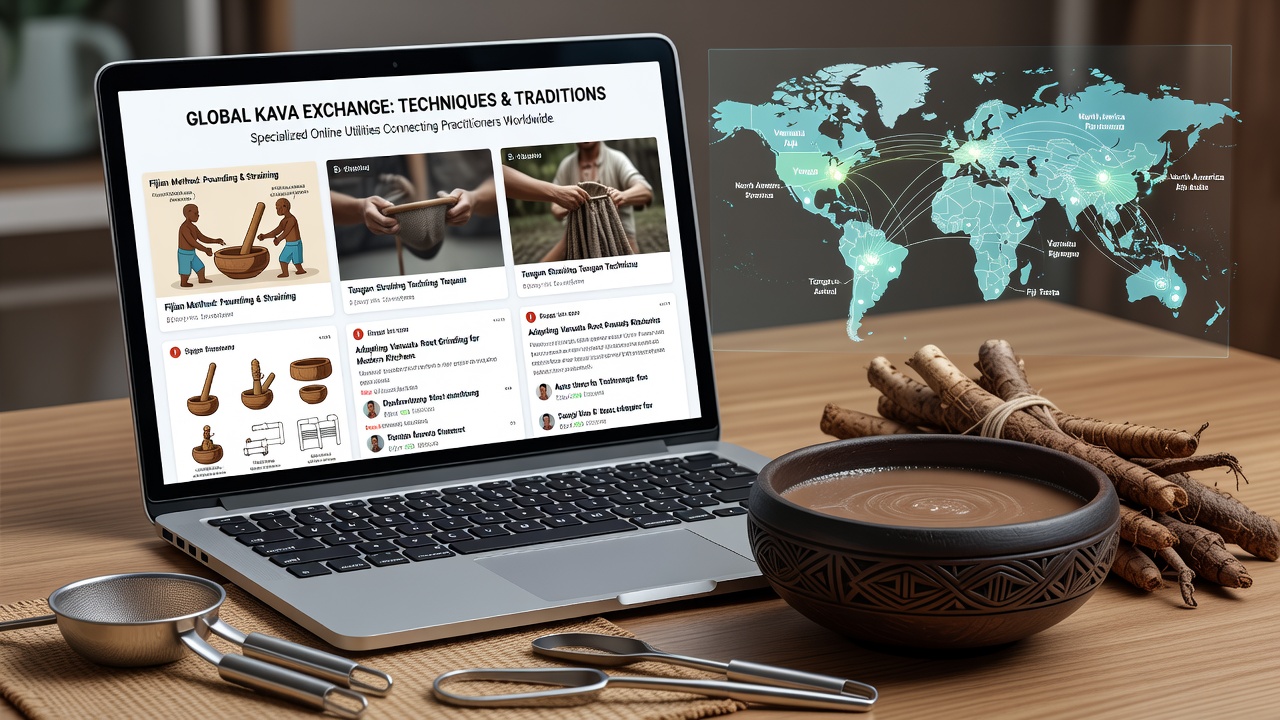
Specialized online utilities have created structured channels for users to share kava preparation techniques across continents, and these systems connect individuals from Pacific island communities with enthusiasts in North America, Europe, and Australia. Platforms designed for this purpose host databases of preparation protocols, video demonstrations, and live discussion forums where participants upload details about root grinding ratios, straining durations, and water temperature controls that influence the beverage's final properties.
Core Features of These Utilities
Users access collaborative tools that include searchable archives of traditional methods alongside user-contributed modifications, while real-time chat functions allow immediate clarification of steps such as the sequence of kneading and filtering. Data from platform analytics indicate that thousands of technique exchanges occur monthly, and these interactions often involve comparisons between noble kava varieties sourced from Vanuatu versus those from Fiji. In October 2026, several utilities introduced updated tagging systems that categorize entries by island origin and preparation equipment type, which helps users locate relevant content more efficiently.
Registration requirements typically involve verification of location and interest level, yet this structure supports focused exchanges without overwhelming volume. Participants upload images of prepared mixtures at different stages, and they attach notes on equipment modifications that adapt traditional wooden bowls to modern kitchen settings. Observers note that these features reduce barriers for individuals outside traditional growing regions who seek accurate replication of ancestral processes.
Regional Participation Patterns
Communities in the Pacific maintain active presence on these utilities by posting baseline techniques that originate from specific islands, and users in the United States and Canada often respond with adaptations suited to available ingredients and tools. Research from the Pacific Community documents how digital sharing complements physical knowledge transfer, while contributions from European users frequently focus on scaling recipes for smaller household quantities. Australian participants contribute data on storage conditions that preserve root potency during long-distance shipping, and these additions integrate into shared repositories without altering core protocols.
Platform operators track engagement metrics that show higher activity during evening hours across different time zones, which facilitates overlap between users in Oceania and those in the Americas. Moderators enforce guidelines that prioritize documented steps over anecdotal claims, and this approach maintains a factual tone throughout discussions. One case involved a group of users who compiled a comparative table of straining times for different root particle sizes, and the resulting resource now serves as a reference point for new members.
Technical Mechanisms Supporting Exchange
Utilities employ version control for technique entries, which allows contributors to propose updates while preserving original submissions for reference. Video hosting features support side-by-side comparisons of traditional versus adapted methods, and text-based tutorials include embedded timers for processes like the standard 10- to 15-minute kneading phase. According to findings published by the National Institutes of Health, accurate documentation of these steps correlates with consistent outcomes across different user groups, and platform designs incorporate prompts that request precise measurements during uploads.
Search algorithms prioritize results based on user ratings of clarity and reproducibility, yet they also surface older entries that retain historical value. Cross-posting functions enable content to move between related utilities, and this connectivity expands the reach of individual contributions. Participants in October 2026 utilized new mobile applications that allow offline capture of preparation sequences followed by automatic synchronization once connectivity resumes.
Documentation and Preservation Outcomes
Archival functions within these utilities store dated records of technique variations, which researchers access to track how preparation practices evolve under different environmental conditions. University studies from the Australian National University have examined how such digital records support cultural continuity for diaspora communities, and the data show increased reference rates during periods of restricted physical travel. Users contribute metadata on factors like ambient humidity that affect mixing efficiency, and these details accumulate into comprehensive datasets.
Notification systems alert registered members when new entries appear in selected categories, which sustains ongoing participation without requiring constant manual checks. Integration with translation tools allows non-English speakers to engage with content originally posted in Pacific languages, and this capability broadens the pool of active contributors. Platform logs reveal that technique exchanges frequently reference equipment sourced from multiple regions, which reflects the global supply chains now common in kava-related activities.
Conclusion
Specialized online utilities continue to expand the scope of kava preparation technique exchanges by providing structured, accessible environments for global users. These systems record, organize, and distribute information derived from both traditional sources and contemporary adaptations, while maintaining focus on verifiable steps and measurements. Participation patterns observed through October 2026 demonstrate sustained interest across diverse geographic areas, and the resulting collections of documented methods serve as reference materials for individuals seeking consistent preparation outcomes.